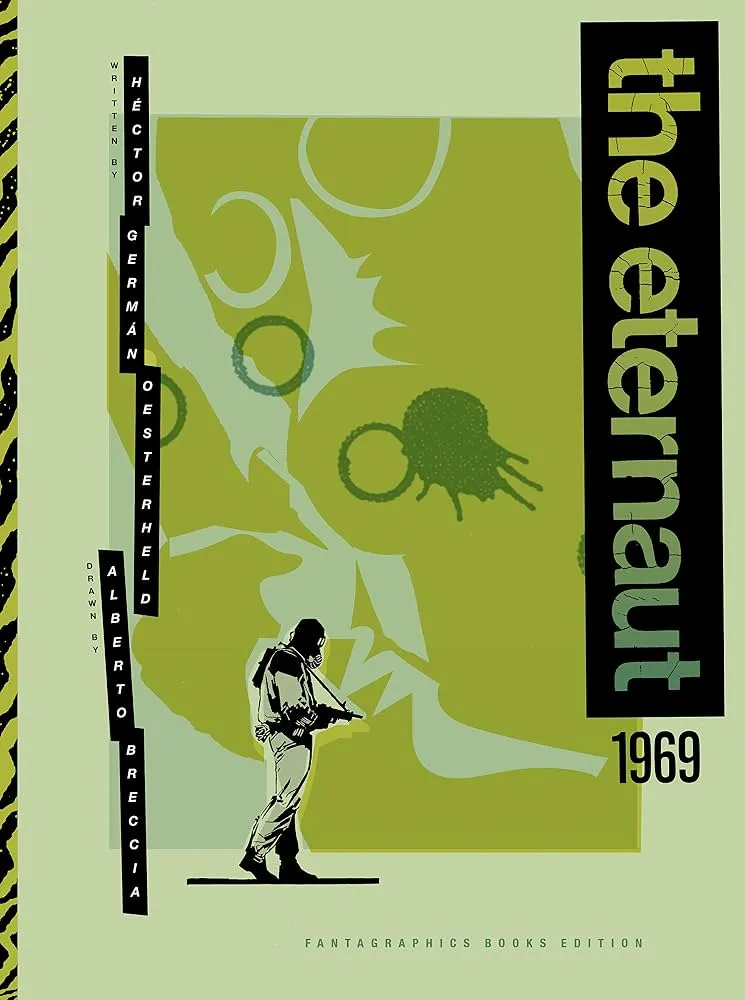
The Eternaut (1969) (1969)
by Héctor Germán Oesterheld, Alberto Breccia
Fantagraphics,ISBN 9781683963523
I was told of this “seminal work of Latin American literature”1 at a bookstore in Minneapolis on June 16 2018. I don’t remember who told me about it though my notes say “MUST READ” with a double underline.
There’s quite a lot going on in the book and with the book. Some spoilers.
The Title
The work in Spanish is titled El Eternauta. It’s a neologism in Spanish, combining the root eter with the suffix -nauta. -Nauta is pretty easy, it’s a cognate, and it translates as -naut, as in astronaut or cosmonaut […] It’s the eter that makes it a little complicated to translate. Well, that, and homophonics, which I’ll get back to briefly. Eter translates literally as ether, but shares a root with eternidad which translates literally as eternity. So the root plays double duty in the Spanish neologism, referring simultaneously to the ether […] and eternity. […] And according to the rule-book of super-literal translation, since eter actually means ether, the language-police-approved right-and-only way to translate it should be The Ethernaut.
For me, that posed a problem. Say it out loud. It’s uncomfortable in English, and uncomfortably close to ethernet, which isn’t very superhero-y. And the language police weighing in on this one in comment threads (I know, I know, don’t feed the trolls) must instinctively agree with me on that, because it’s not the “correct” title that’s been proposed. What this commenter, and some very vocal others, have preferred is an Anglicization of the Spanish neologism: The Eternaut. So just lopping off that final vowel, that telltale Spanish syllable, makes it an English neologism. And I think neologism for neologism is the way to go, at least in this case. But say it out loud. Really, do it. ETER-NAUT. Did you say it “eat-or-not”? Because that is just absurd. Especially if you’re not constrained by literalism, which this neologism isn’t because, as we’ve already learned, eter means ether not eternity.
I really do wonder if The Nerds would’ve been hung up on how close it sounds to “ethernet”.
The Editions
There are two versions of the series, which was created by Hector Oesterheld.
The first, called “The Eternaut”, was published between 1957-59 with artwork by Francisco Lopez. No politics, just good 'ol alien invasion drama (from the sound of it.) It was published as a comic strip over 106 weeks and “was a massive success”.
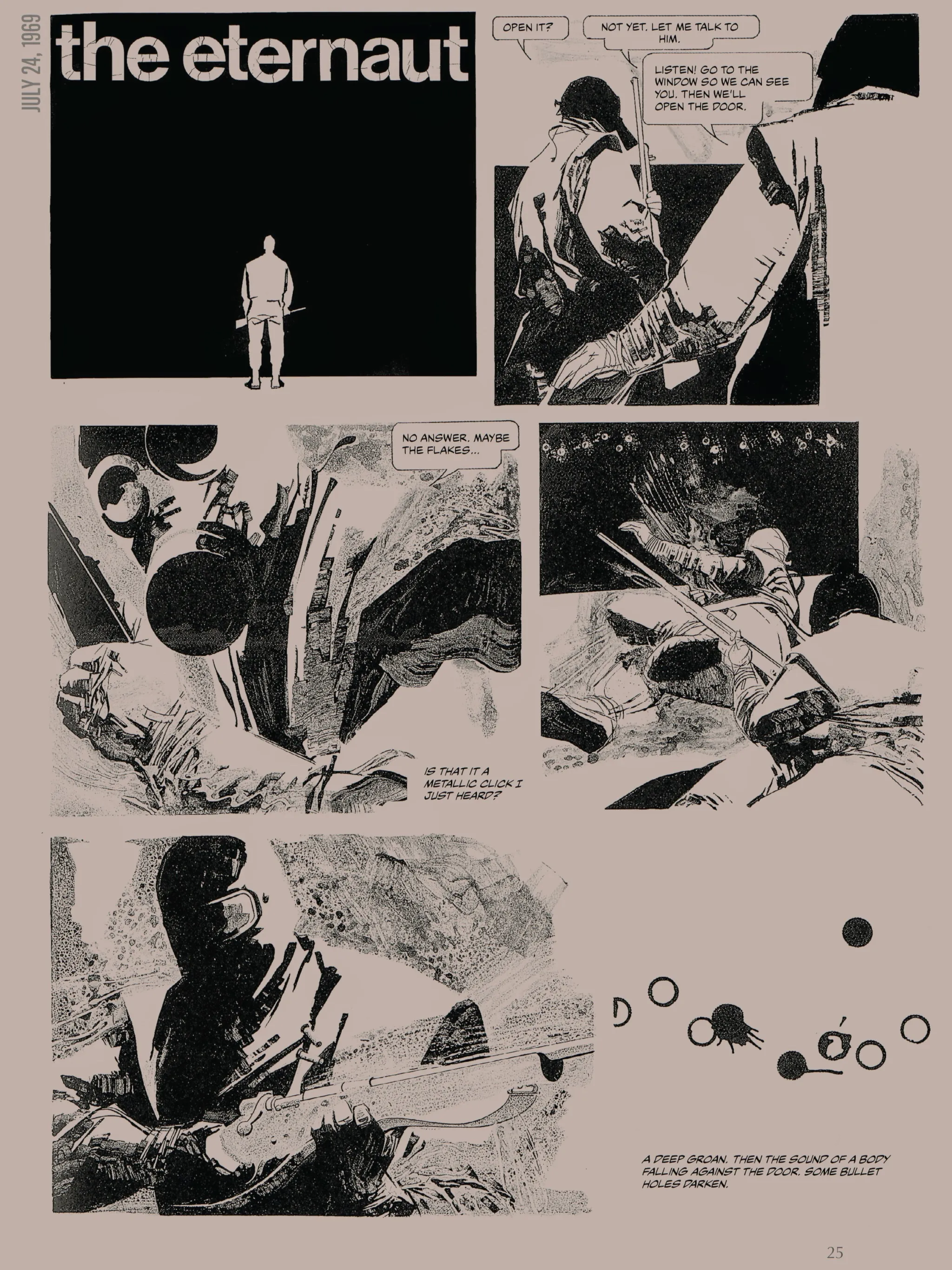
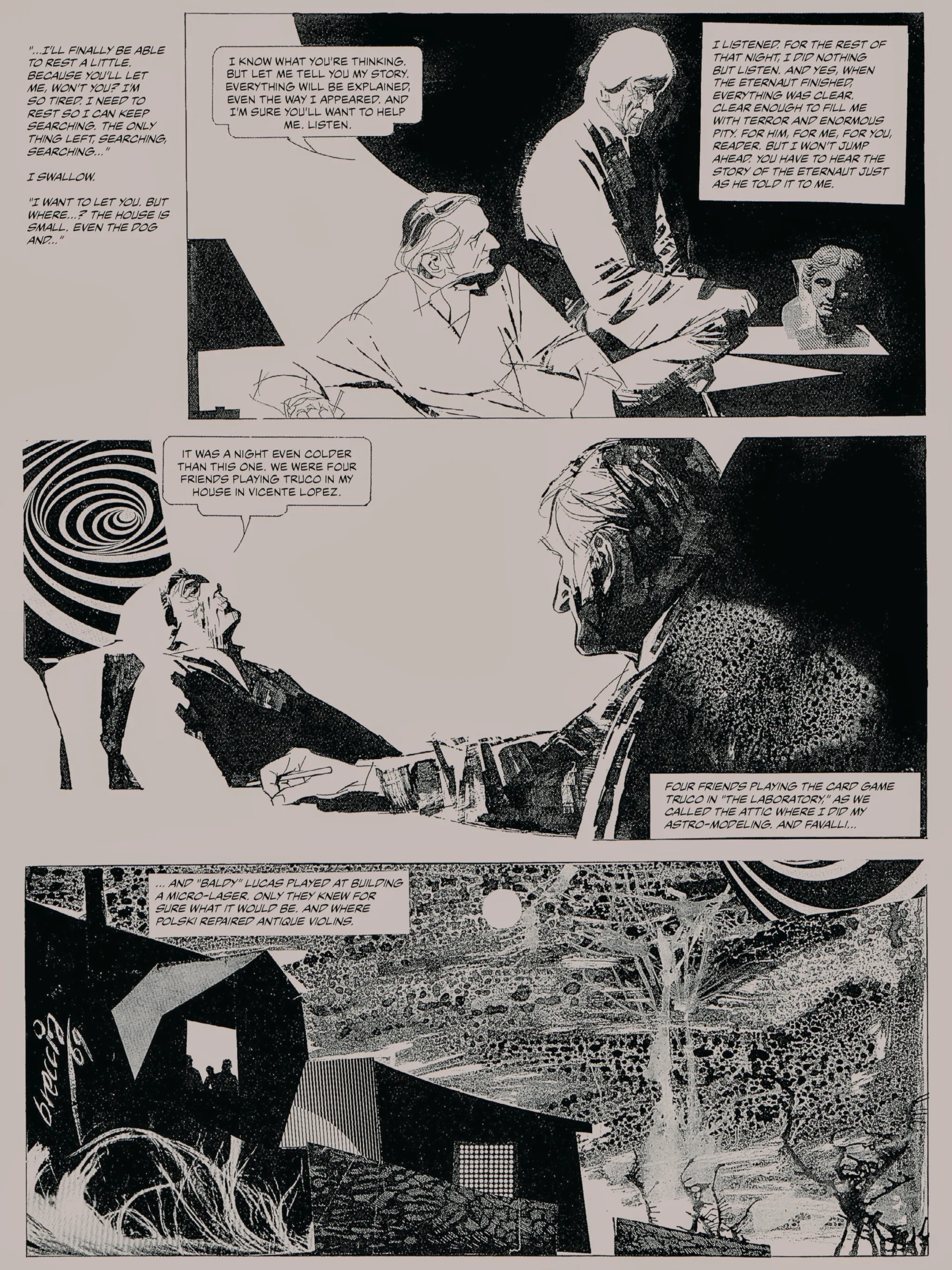
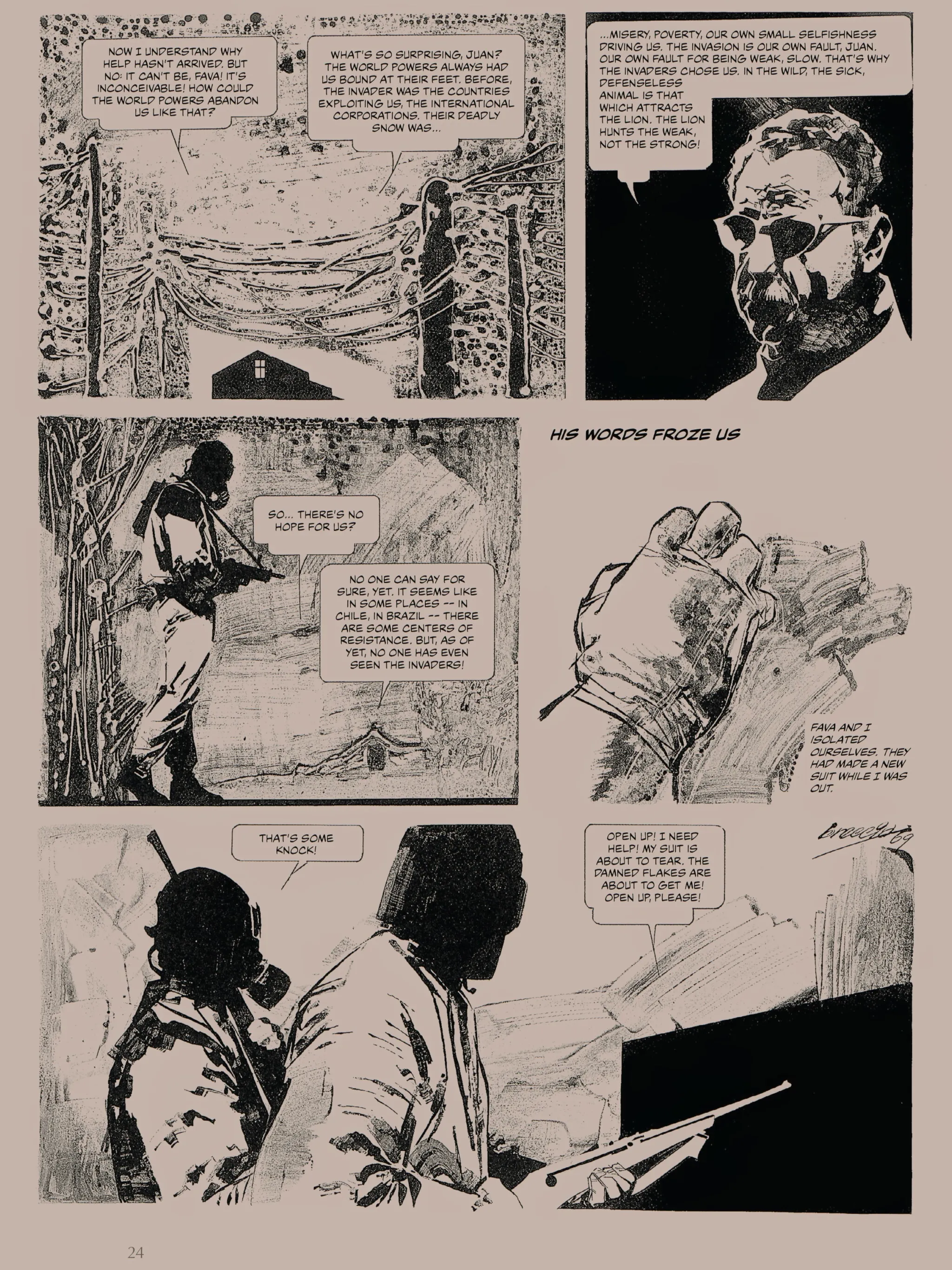
The second is a reboot called “The Eternaut 1969”. It had a pronouced political tone (given the Cold War’s effects in South America), was published in a gossip magazine (!), and featured a different artist, Alberto Breccia. People didn’t take too well to his art/treatment. He refused to budge and the series was canceled. Oesterheld then pushed for its completion. Enjoyed great success in France and Spain however. This is the version I read.
During the story’s serialization, Breccia was asked to change his art, to make it more commercial by toning down its more expressionistic elements, but he flatly refused. The decision was finally made to cancel the series, with Oesterheld being allowed to rush the series to a conclusion by cramming almost half of the story’s original plot into a couple of installments.
There’s a Netflix show too.
Oesterheld & Breccia
Oesterheld was a big figure in Argentinan graphic novels and comics who led quite the life. Geologist by training, big critic of the dictatorships, super Leftist, was disappeared and presumably killed by that government (along with his four daughters.)
Frank Miller is a big fan of Breccia who appears to be another giant in Argentinan graphic novels and comics.
The Book
There’s time travel and stable loops and all that lovely stuff with enough political and social commentary. But it’s pretty hard to figure out and to see what’s going on. How Breccia draws the aliens is certainly an interesting choice. Thought it was just me getting old and inflexible with an auteur’s wild and expressionist style and was a bit relieved to read that I wasn’t alone in squinting and making “wtf” faces at the panels.
Excellent fore and afterwords by Erica Mena and Rodrigo Baeza that situate the work historically and explain its importance.
Looking forward to reading The Eternaut.
According to Erica Mena (fellow Hawkeye and) the translator of both editions by Fantagraphics.↩︎